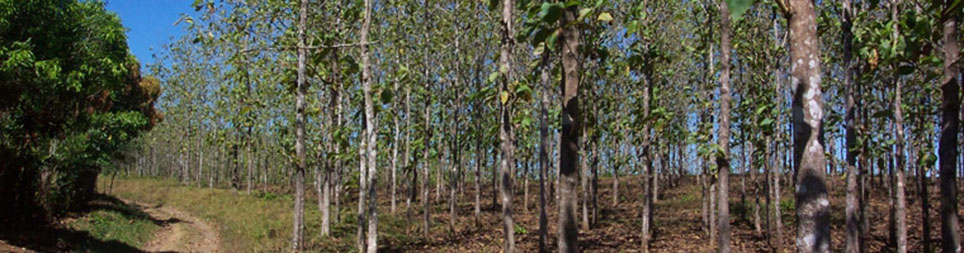
Although relatively unimportant in terms of the volume of world timber production, because of its strength and aesthetic qualities teak is the tropical hardwood most in demand for a specific market of "luxury" applications including furniture, shipbuilding and decorative building components. Consequently it is of major importance in the forestry economies of its main producing countries.
Experiences with growing and marketing teak are of considerable relevance to growers of other high-value hardwood species, particularly in the tropics. Species such as mahogany (Swietenia macrophylla), red cedar (Cedrela odorata) and rosewood (Dalbergia sissoo) face similar challenges of competing in high-value niche markets, have longer growing cycles than many softwoods and present similar environmental concerns associated with harvesting from tropical forests. While some of the issues discussed here are largely unique to teak as a species, many are relevant to other valuable hardwood species.
During the past 20 years supplies of teak wood from natural forests have dwindled, consequently an increased interest has developed in the establishment of teak forest plantations. The transition towards greater utilization of plantation-grown teak is not, however, being made without difficulty or controversy. Until recently, misgivings over the environmental impacts of teak plantations - particularly controversies regarding possible soil deterioration and erosion in pure teak plantations - rivaled those often associated with eucalyptus plantations. Further controversy has been generated in several countries by the promotion of teak plantation investment schemes based on unlikely growth and yield projections, unrealistic pricing scenarios and dubious fund management strategies. Problems have mainly resulted from insufficient regulation and inadequate information or investor education. The long time horizons and broad range of price predictions associated with teak plantation investment have provided opportunities for less scrupulous entrepreneurs to exaggerate figures and deceive even moderately wary investors.
Nonetheless, with teak maintaining the status as one of the world's most valuable timbers, interest in growing and investing in the species will remain high in this economically viable solution to the production of much needed wood. Legislation and vigilance in both the commercial and the environmental spheres has been progressing to ensure that the teak-growing industry develops in an orderly fashion.