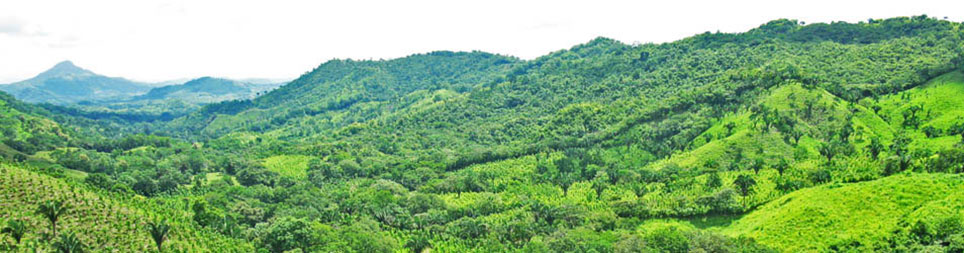
Our company's forestry management methods focus on the long-term value growth of your holdings.
The benefits of Panama Teak Forestry's methods are best illustrated when we can manage a teak property throughout the entire growth cycle, from planting through final harvest. In cases where we have purchased existing teak properties, we tailor our management methods to get the best possible yield from each project.
Panama Teak Forestry also provides management services to 3rd party plantation owners. We can offer just the final harvest and sales of teak plantations harvested wood and logs from thinning that the owner wishes to sell to complete forestry management from sourcing the land and managing the plantations from soil prep, and planting to final harvest. The majority of our services are devoted to the thinning, extraction, and sale of teak logs. In our services, we listen to what you the owner wants to achieve and discuss the best options for you. With over 20 years of plantation management services in Panama, we are the oldest Teak plantation management company in Panama. Contact us if you have teak or teak plantations for sale.
We believe that high-density teak properties with a 30-plus-year rotation provide maximum return on investment. We begin by planting 1100 trees per hectare. Our trees thrive in a higher-density setting, which increases the total quantity of top-quality wood available at harvest time. Although more expensive initially, and requiring more intensive thinning early on, the higher-density teak tree spacing at planting provides a better return over the life of the project because it results in taller, straighter, healthier trees.
As the teak grows, we cut back the surrounding underbrush just enough to keep the trees healthy. This prevents soil erosion and adds to the biodiversity of Panama Teak Forestry´s property. Along the waterways running through our properties, we preserve the natural habitat by maintaining a mix of native trees and vegetation.
The cultivated teak trees are thinned initially at 3 to 4 years, then again at age 7 or 8, leaving 600 to 800 trees per hectare. The third thinning occurs in year 12, leaving 400 to 500 trees per hectare. The forestry engineers may decide to thin the trees to 350 to 400 per hectare in year 15, or they may choose to skip the 15-year thinning. In year 18, the trees are thinned to 220 to 260 trees per hectare. When healthy teak trees are 25 years old and have reached commercial size, forestry managers can choose to do a complete harvest or thin the stand to about 150 trees/hectare and let the trees keep growing.
When healthy teak trees are 30 years old and have reached commercial size, they contain about 1 cubic meter of heartwood. This translates to 200 to 260 cubic meters of heartwood per hectare, depending on the number of trees. When a stand of trees is 30 years old, forestry managers may choose to:
The decision on when to harvest a mature stand of teak is typically based on current teak prices, cash flow needs, and other financial factors, such as taxes. On well-managed properties, growth is continuously monitored in test plots to help determine the optimum timing for thinning and harvest.
For a more complete discussion of teak and teak land management, see the Teak Information section of the website.